01
Flush monopiles
Chords tie directly to the monopile head via a bolted transition adapter.

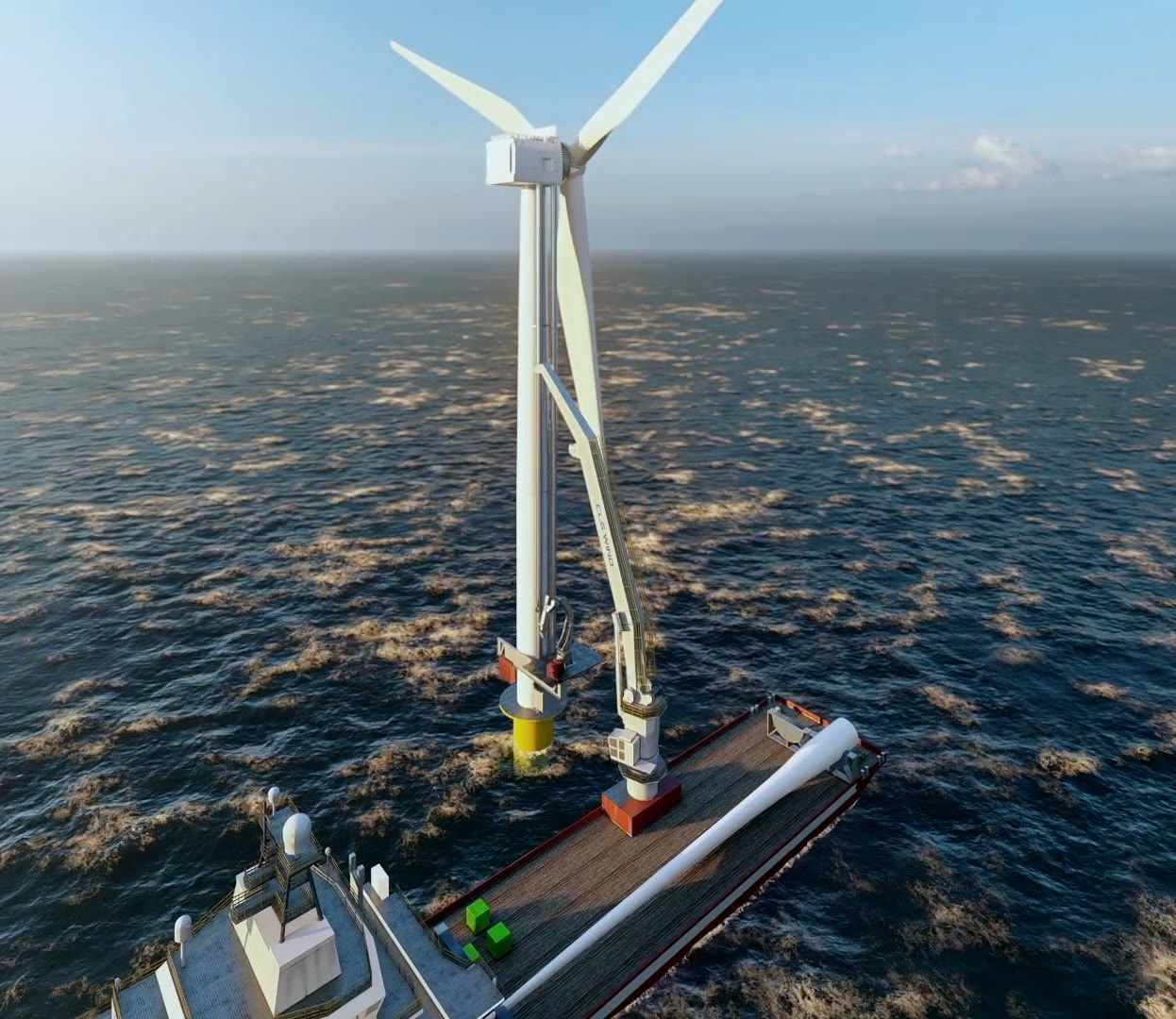
Elevating and installation systems for offshore wind, with variants for fixed-foundation and floating platforms.
Operates from the smaller crane vessels widely available in the offshore oil and gas market. Approval in Principle from the American Bureau of Shipping for the 15 MW offshore concept.
Installation campaign for a fixed-foundation project: conventional WTIV vs ORCA LIFT™.
Modeled from real project values. USD primary; EUR in parentheses.
Conventional install
2,500-ton-class WTIV, full project
$205M (€190M)
ORCA LIFT
Smaller crane vessel, scaled platform
$53M (€49M)
Saved
$152M 74%
§ 01
Only five vessels in the world are suited to both installing and exchanging major components on a 15 MW turbine. They are committed to new-build work, take up to three months to mobilize, and cost about $250,000 to $370,000 a day (£190,000 to £275,000). Floating wind compounds the problem with 6,000-ton port cranes and $100M-plus port investments. Conventional weather windows limit useful working days to 40% to 60% of the calendar.
§ 02
ORCA LIFT operates from a sub-1,000-ton crane vessel with a sub-100-meter boom. The vessels are amortized, widely available in the offshore oil and gas market, and crewable locally.
Vertical lift loads travel from the platform through ORCA LIFT's structural chords into the foundation, monopile, or floater. The existing tower only sees a small stabilizing load at the flange, its strongest point, used to maintain verticality and prevent buckling on the slender chord members.
This is why a single platform serves fixed and floating foundations, most OEM platforms, and both new installation and in-service component replacement, without modification of the turbine tower design. Load modeling by Arup for fixed offshore and Kent Engineering for floating.
Once a component is fastened to the elevating platform, it is carried on a guided path, not suspended from a hook, so it does not swing. The only crane lift is the short transfer to the platform at the base of the tower, and because that lift is short, pendulum and dynamic amplification are reduced.
Conventional offshore lifts lose useful working days to weather: a 2,500-ton-class WTIV stops lifting well before the wind would otherwise stop the project. ORCA LIFT extends the operational window into wind conditions that would shut a crane lift down, converting calendar days into project days.
01
Chords tie directly to the monopile head via a bolted transition adapter.
02
An intermediate collar distributes load around the larger diameter.
03
Chords land on prepared nodes at the jacket top.
04
Chords attach to a dedicated landing plate on the floater deck, outside the tower load path. Modeled by Kent Engineering on a three-column semi-submersible.
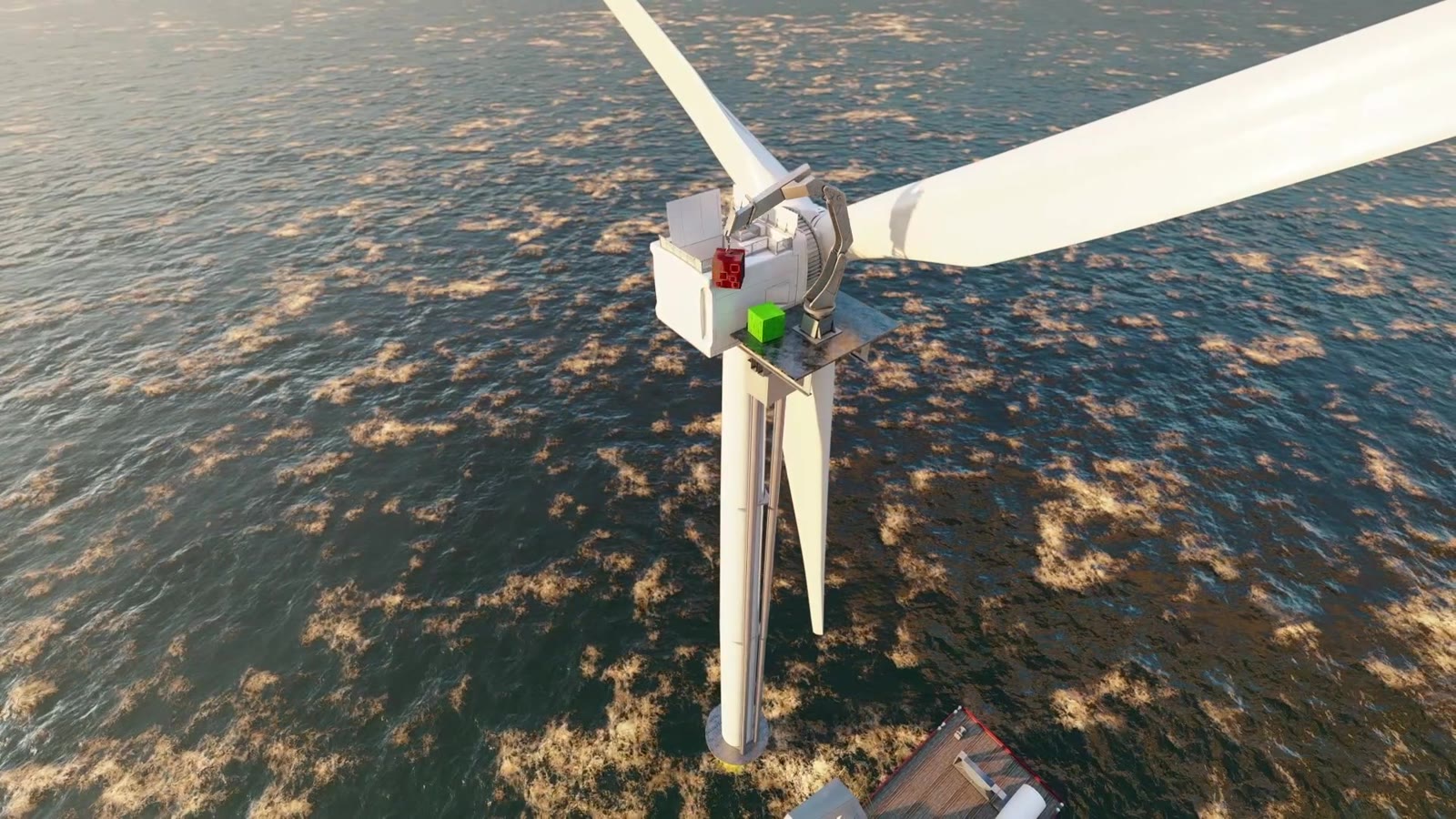
As offshore wind moves into deeper water, every heavy lift over a turbine's life runs into the same wall. Installing it, replacing a major component, and removing it at end of life all rely on vessels that stand on the seabed. Jack-up reach runs out at roughly 50 to 60 meters of water depth, and a fixed foundation cannot be towed to port. Past that depth, there is no established way to lift.
ORCA LIFT does not stand on the seabed. It mounts to the turbine's own foundation and carries the lift through the structural chords, so its working range does not depend on water depth. The same platform installs a turbine in deep water, services it, and decommissions it, in place, from the crane vessels already available in the market.
For developers moving into deep water, this is not an efficiency question. With no jack-up that can reach and no way to tow a fixed structure, an on-foundation platform is the only practical way to install, service, and eventually remove the turbine, and it is what CLS Wind is built for.
Smaller, available vessels
Works from smaller, widely available vessels rather than the scarce, expensive 15 MW-class vessels.
Foundation-agnostic
Lands on flush or oversized monopiles, jackets, and floating platforms, outside the existing tower load path.
No mega-port build-out
Serves floating fields without 6,000-ton port cranes or $100M-plus port investment.
Proven supply chain
Redeploys the offshore oil and gas vessel fleet and local crews, built on more than 70 years of jack-up engineering.
Third-party validated
Load modeling by Arup (fixed base) and Kent Engineering (floating). ABS Approval in Principle for the 15 MW offshore concept.